Seollal family observances
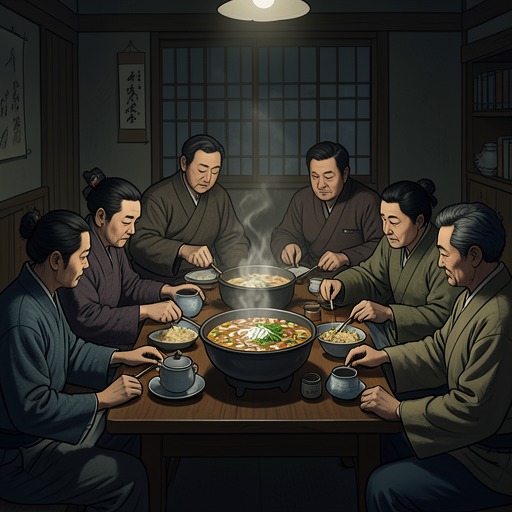
Winter in SokchoSeollal family observances are presented as both a recurring family duty and a demanding practice of cooking, hosting, and eating. The holiday’s customary sequence—Tteokguk with family, followed by a cemetery visit to leave rice balls on ancestors’ graves—gives the narrator’s household a shared ritual, but the preparations also expose differences in skill, authority, and intimacy.
Ritual and preparation
The narrator describes it as customary for families to celebrate Seollal together. The meal is followed by a visit to the cemetery, where rice balls are placed on ancestors’ graves. Her mother expects her to attend, making participation an obligation as well as a family observance.
The narrator arranges the practical work in advance: she will cook the Tteokguk before leaving, so Old Park can reheat it for himself and the girl with bandages. She also includes Yan Kerrand as a possible guest, though only if he chooses to sample her cooking. The plan shows how the holiday is carried not only by the formal gathering but by advance labor and food left ready for people who might otherwise be on their own.
The wider town is dressed for the occasion. Lights stretch along Sokcho’s main street toward the great steel arch, where an inflatable dolphin hangs above Rodeo Street. Against this public display, the narrator’s arrangements are modest and domestic: a pot of soup, a meal to be reheated, and an uncertain invitation.
Food, skill, and authority
In the week before Seollal, the narrator accompanies her mother to a stall near the port. Her mother orders a vegetable and seafood pancake and rice wine while discussing the late fish catch and her need to obtain Fugu for the holiday meal. With only Octopus available, the desired ingredient remains unresolved. The narrator, meanwhile, weighs each mouthful before eating, then loses control and eats and drinks rapidly until she feels sick. The meal meant to provide time together instead reveals the narrator’s distress around food and her difficulty regulating it in her mother’s company.
The mother’s authority in the kitchen rests on specialized expertise. She is the only fishmonger in Sokcho licensed to prepare Fugu, whose organs contain lethal toxins; she uses its translucent flesh to impress guests. While preparing the fish, she removes the poison-laden intestines, ovaries, and liver without piercing them. The narrator watches but is never allowed to handle Fugu. Their shared work therefore does not mean equal access: the mother’s professional knowledge sets a boundary around what her daughter may do.
That division is sharpened by the narrator’s own identity as a cook. At Old Park’s guest house, she regards the kitchen as her domain and says that Old Park does not interfere with her cooking. Her mother, by contrast, protects the dangerous precision of Fugu preparation as her own. The holiday table depends on both women’s labor, but their culinary roles and authority are not interchangeable.
The family gathering
For the gathering, the narrator and her mother wear traditional outfits and arrange cushions on the tiled kitchen floor. The narrator’s aunt arrives in a tailored suit and heavy makeup, laughs at their clothing, and treats the traditional dress as out of place in the present day. Her reaction makes the observance a site of disagreement over how visibly tradition should be worn, even within the family.
The aunt is delighted by the Fugu sashimi, which she says she avoids in Seoul because she distrusts the chefs who claim to be licensed there. She fears that Japanese chefs might knowingly poison Koreans, and invokes the lethal danger of even a small amount of toxic flesh. Her praise of the sashimi thus carries suspicion as well as pleasure. She then notices the grayish color of the Octopus dish. The mother explains that the narrator pierced its ink sac, turning a mistake in preparation into a public criticism of her daughter’s knife work.
The scene joins the ceremony’s hospitality to its risks and frictions. The mother’s expertise produces the dish that wins the aunt’s admiration, while the narrator’s error becomes part of the family conversation. The meal is not simply an emblem of harmony: it makes visible who is trusted with which tasks and whose work is judged.
Care beyond the ritual
The narrator’s holiday preparations extend care beyond the immediate family. She plans soup for Old Park and the bandaged girl as well as a possible serving for Yan Kerrand, whom she does not assume will accept. Later, she tells Yan Kerrand that she would like him to taste her cooking. This invitation is not itself identified as part of the Seollal observance, but it echoes the earlier offer to include him at the holiday meal. Cooking becomes one way the narrator tries to make a place for another person, even when his attention seems elsewhere.
Seollal therefore gathers several kinds of food labor into one recurring occasion: the ancestral offering of rice balls, the family Tteokguk meal, the mother’s exacting preparation of Fugu, and the narrator’s work to feed people at the guest house. The ritual promises reunion and continuity, yet its scenes also hold unease, judgment, and uncertain invitations. Its meaning lies in that tension between a custom that brings people to the table and the uneven relationships they carry there.